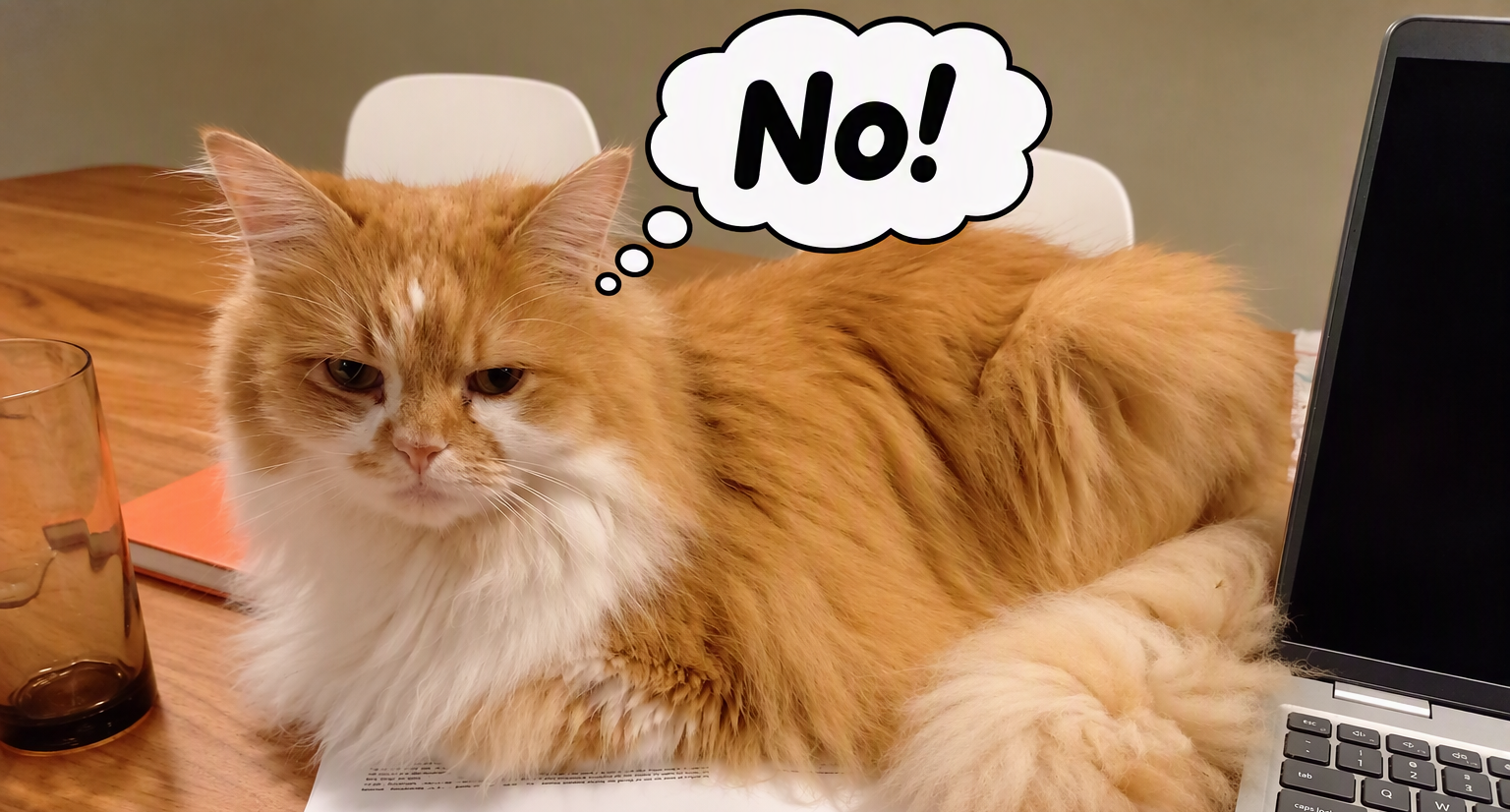
It's my job as an advisor to say no
- Merlijn Sebrechts
- University
- October 10, 2026
Table of Contents
Over the past few months, I’ve had multiple conversations with PhD students around a similar topic: the fact that a significant part of my coaching involves critiquing their work and suggesting alternatives.
Since I’ve had many similar conversations in a very short timespan, I wanted to refine and put down in writing my thoughts about criticism in science and its impact on mental health.
Criticism in science
I see it as my responsibility to show you how you can improve your work and your thinking. Anything you write, create and do will receive lots of feedback pointing out flaws and weaknesses. I can be very argumentative when discussing your subject.
There are two reasons for this.
- The first one is that science is an adversarial process. Science is the process of challenging ideas. Knowledge is what remains when, despite our best effort, we cannot refute an idea. It’s evolutionary epistemology: brainstorming supplies a wide variety of ideas, and criticism filters out the bad ones. So as a researcher, it is important to be very critical of ideas and actions, even your own. That is simply how we generate knowledge. I argue to better understand ideas.
- The second one is that during a PhD you’re expected to grow beyond your advisors. While it starts with us teaching you everything we know, the end goal is that you’ll know more than we do. As such, at a certain point, we stop knowing what the right answer is. We can only point out the issues that we can still see.
Taking this into account, it is very important to know that my goal is not for you to do exactly what I say. Since it’s my goal to teach you to be critical, that means you need to be critical of my opinions too. The main purpose of my suggestions is so you can better understand the issues and how to resolve them. The end goal, however, is for you to move beyond what I can propose.
I make lots of mistakes, and half of my ideas are shit. So I don’t want you to follow exactly what I tell you to do. However, it’s very important that you understand why I have an opinion, even if just to explain to me why I’m wrong. “Learn the rules like a pro, so you can break them like an artist.” or “The point of the fence isn’t the fence, it’s whatever the fence was built to protect. Before you tear it down, you should understand why it was put there.” Don’t follow advise blindly, but don’t dismiss it before you understand it.
The human dimension
A culture of critique has the potential to turn toxic very quickly. It is much easier for me to critique something than to praise something. Critiquing is a second nature to me while praise is something I have to remind myself to do. As such, it’s a delicate balance to avoid the more toxic parts of academic culture.
Part of the solution is to focus on critiquing ideas instead of people. Energy should be directed at the argument, not the arguer. But people identify with their ideas, so attacking their ideas can feel like a personal attack. We can alleviate this somewhat by helping you create “epistemic detachment”: helping you hold ideas loosely enough to let them be examined. But this should not absolve us of responsibility when we hurt you.
It is normal to be hurt by criticism and we should take that into account. Regardless of what you naturally know, your lizard brain still generates emotions detached from that. Tone can help a lot there. Discussions need to remain “fun”, and creating a broader welcoming culture can really help people feel safe enough to see it’s not a personal attack. Both the ideas of “feeling safe enough to take risks” and “feeling safe enough to fail” are important here. You cannot skip to “rigorous criticism” without having built relationships and mutual respect. In a safe environment, feedback to me feels more like a puzzle to solve, rather than a rejection.
A second part of the solution is to be mindful of power dynamics. Criticism is only productive when it can flow in all directions. I really want us to have an environment where everyone gives criticism to everyone, regardless of status.
But I think the most important part is to focus on addressing failure when it happens. If I hurt you, say it explicitly so I can apologize and try to improve. I don’t think anyone wants to make co-workers unhappy, and I’m no exception. I can’t promise to create a perfect working environment, but I can promise to listen to feedback and apologize when things go wrong.
In conclusion
Critique is an important part of knowledge generation and becoming a scientist. However, the adversarial process only works if both of us can show up to it fully. That means I have to be honest, but also that I have to create an environment where my students can handle that criticism. The goal is to test if your ideas can survive criticism, not to see if you can survive criticism. I should try hard to create an environment where the first does not feel like the second.
Acknowledgements
Thanks to Anne Fonteyn and Amos Sebrechts for their valuable feedback on draft versions of this article.